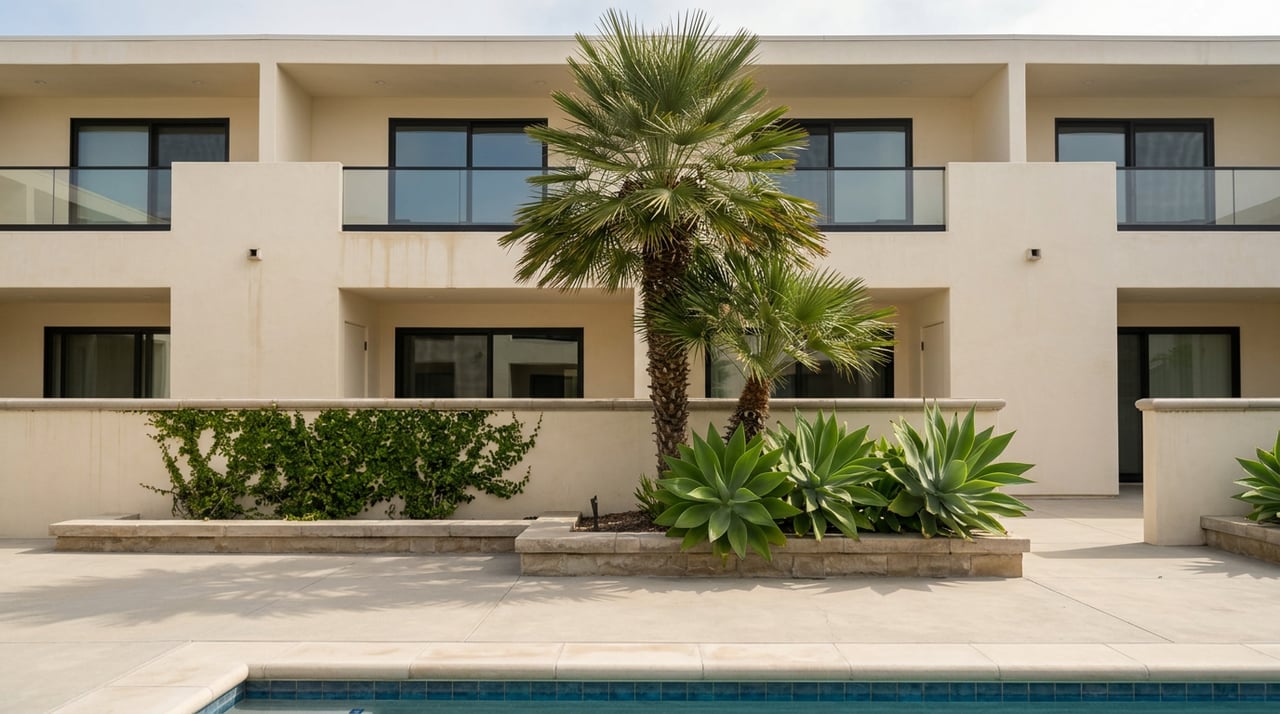
A buyer's agent working a closing at The Metro pulled the tax bill during inspection and stopped. The Mello-Roos line item didn't match the unit. The special tax was calculated as if the condo measured more than 1,850 square feet. County records and every other source the agent checked put the actual size closer to 1,670. The owner had been paying on the wrong number, through at least one prior sale, without anyone catching it. After an appeal, the annual charge dropped from $3,742 to $2,975. A difference of $767 a year, sitting unnoticed for who knows how long, on a line item most buyers glance at once and never open again.
That's not a cautionary tale about one careless owner. It's a preview of what's actually happening every time someone quotes a single median price for Playa Vista. The number on the portal is smoothing over a set of costs, tax structures, and even market segments that don't behave the same way, and in at least one documented case, weren't even calculated correctly to begin with.
The Fee Nobody Rechecks
Mello-Roos is not a mystery charge. It's a special tax tied to a Community Facilities District, in this case the one that shows up on LA County tax bills as Playa Vista CFD4, and it exists because the community's original infrastructure, roads, parks, utilities, was financed through bonds rather than paid upfront. The tax repays that bond, and it's calculated by square footage, not assessed value, which means it doesn't move with market swings the way regular property tax does. It can escalate by as much as 2 percent a year, and the bond backing it is set to mature in 2031, at which point the charge is expected to end for the units still carrying it.
Here's the part that doesn't show up in any listing sheet: the square footage figure used to calculate that tax comes from a registration made years ago, and nothing forces anyone to recheck it when a unit resells. It sits there, correct or not, until someone with a reason to look actually pulls the county assessor's number and compares it. That's what happened at The Metro. There's no reason to assume it's the only unit in the community where the two numbers don't match.
Same Community, Two Different Tax Bills
The bigger structural fact, though, is that Mello-Roos doesn't apply evenly across Playa Vista at all. It applies to Phase I, the original construction built roughly between 2003 and 2011, where the infrastructure bond financed the work. Phase II, built later, has no Mello-Roos tax because its developers paid those infrastructure costs directly and folded them into the sale price instead.
That single distinction changes the monthly math on two otherwise comparable units by a meaningful margin.
| Phase I | Phase II | |
|---|---|---|
| Mello-Roos tax | Yes, based on registered square footage | No |
| Typical annual impact | Roughly $3,000, higher for larger units | $0 |
| Approximate monthly impact | $250 to $310 | $0 |
| Bond maturity | 2031 | Not applicable |
| Base property tax | Standard LA County rate, roughly 1.1% to 1.2% | Same |
A buyer comparing two units at the same price point in the two phases isn't actually comparing two equivalent monthly payments. One of them carries a fixed extra cost that the other doesn't, and that cost is baked into the tax bill rather than the sticker price, which is exactly why it's easy to miss until escrow.
Two HOAs, Not One
Mello-Roos is only half the picture. Every owner in the community also pays into a master association, PVPAL, currently running around $375 a month, on top of whatever the individual building charges. Building-level HOA dues vary widely depending on the amenities and unit count, running anywhere from roughly $250 a month in a smaller, lower-amenity building up past $1,000 in one with a pool, concierge service, or fewer units splitting a bigger maintenance budget.
Buildings like Skylar, Mason, and Serenade have set some of the higher price-per-square-foot benchmarks in the community, largely tied to architecture and floor plan. Others, like Seabluff, with its typical three-bedroom layout near 1,315 square feet, or The Metro, where two-bedroom units run closer to 1,651 square feet, sit at different price and fee points depending on age, unit mix, and what the building's HOA actually covers. Some Phase I buildings still include water in the monthly dues. Most single-family homes and Phase II buildings do not, which means two owners paying similar HOA totals can be covering very different lists of expenses.
The practical result is that "HOA fees" in Playa Vista is really shorthand for two separate bills that have to be added together, layered on top of a Mello-Roos charge that may or may not apply, layered on top of standard property tax. None of that shows up as a single number anywhere a buyer is likely to see it before they've already fallen for a specific unit.
The Fee That Has to Be Cash
One more cost catches people at the closing table specifically. Every time a Playa Vista property changes hands, 0.75 percent of the sale price goes to Playa Vista Community Services, funding park upkeep, seasonal events, and wetlands preservation. On a million-dollar sale, that's $7,500. Who pays it, buyer or seller, is negotiable and shifts with market conditions. What isn't negotiable is that it has to be paid in cash at closing. It can't be rolled into the loan. For a buyer who has stretched every dollar toward a down payment and closing costs, discovering a five-figure cash requirement they can't finance is the kind of surprise that should be raised in the first conversation with an agent, not the last week of escrow.
What the Median Is Actually Averaging
Put all of that together and the headline median starts to look less like a single market and more like an average of markets that don't belong in the same sentence. As of August 2026, the median list price across Playa Vista sat around $1.27 million, down roughly 6 percent year over year, with homes spending a median of 62 days on the market. That number blends Phase I units carrying Mello-Roos with Phase II units that don't, blends buildings with $250 HOA dues against buildings north of $1,000, and blends condos against a single-family segment that barely functions as a market at all. A snapshot pulled from live MLS data in early June 2026 found exactly one active single-family listing in the entire community, priced at $3.499 million, with zero closed single-family sales in the trailing 90 days. Whatever a single-family "median" implies for Playa Vista, there wasn't enough transaction volume behind it to mean much.
Condo-specific data from July 2026 told a narrower, more useful story: 38 condos listed, an average of $866.46 per square foot, and a median list price of $1,199,000, sitting below the blended community-wide figure because the blended figure includes higher-priced product types the condo segment doesn't touch. A buyer who anchors to the $1.27 million headline number without separating out what phase, building, and property type actually built that number is negotiating against a figure that was never describing their unit in the first place.
Questions Worth Asking Before You Write an Offer
A few questions catch most of what the median hides:
- Is this unit in Phase I or Phase II, and does the tax bill show a CFD4 line item?
- What is the unit's registered square footage on the county assessor's record, and does it match the listing?
- What does the building's HOA actually cover, water, cable, insurance, versus what the master PVPAL fee covers separately?
- Who is expected to pay the Community Enhancement Fee, and has that been discussed before the offer is written?
- If Mello-Roos applies, what is the current annual figure, and does it match the unit's actual size?
None of these require a specialist. They require someone willing to pull the actual tax bill and compare it against the county record rather than taking the listing sheet's word for it.
Quick Answers
Does Mello-Roos disappear for everyone in 2031? Only for the bond it's tied to. Phase II never had it, and Phase I's obligation is expected to end when that specific bond matures, though the exact timeline should be confirmed against the current CFD annual report rather than assumed.
Is Mello-Roos tax deductible? It depends on how the specific levy is structured, and the answer isn't the same in every case. This is a question for a tax professional, not a real estate agent.
Can a buyer negotiate who pays the Community Enhancement Fee? Yes. It's a closing cost split that shifts with market conditions and is worth raising early rather than late in escrow, since it has to be paid in cash regardless of who covers it.
Playa Vista rewards buyers who read past the headline number, and punishes the ones who don't with a tax bill or an HOA statement they didn't budget for. If you're comparing a specific unit against what similar properties in the community are actually carrying in fees, Azure Hynes can walk through the phase, the building, and the real monthly math before you're the one signing at closing. Let's connect.